
The human voice is a powerful instrument. It conveys emotion, builds intimacy, and establishes trust in a way that plain text never can. For years, victims of online romance scams have longed to hear the voice of their supposed partner, seeing it as the ultimate proof of their legitimacy. A phone call or a voice note could dispel doubts and solidify a connection that was, in reality, a carefully constructed fantasy. But the digital landscape has shifted. The rise of sophisticated artificial intelligence and voice cloning technology has turned this very proof into a scammer’s most potent new weapon. A familiar voice, once a source of comfort and validation, is no longer a reliable indicator of identity. It has become another tool in the arsenal of deception, making it more critical than ever to understand the threat and learn how to protect yourself.
In this article, we will delve into the dark intersection of AI and emotional manipulation. We will explore how scammers are leveraging AI-generated voice notes to create hyper-realistic personas, build false intimacy, and execute urgent, high-pressure financial requests. More importantly, we will provide you with a clear, actionable guide on how to verify the identity of the person you’re talking to, moving beyond voice recognition to more foolproof methods. Understanding these new tactics is the first step in defending yourself against the evolving threat of sophisticated romance scams.
Spis treści:
- The Evolution of Deception: From Catfishing to AI Voice Cloning
- The Psychological Weapon: How AI Voice Manipulates and Persuades
- Your Defense Toolkit: How to Verify Identity in the Age of AI
- What to Do When You Suspect a Scam or Have Become a Victim
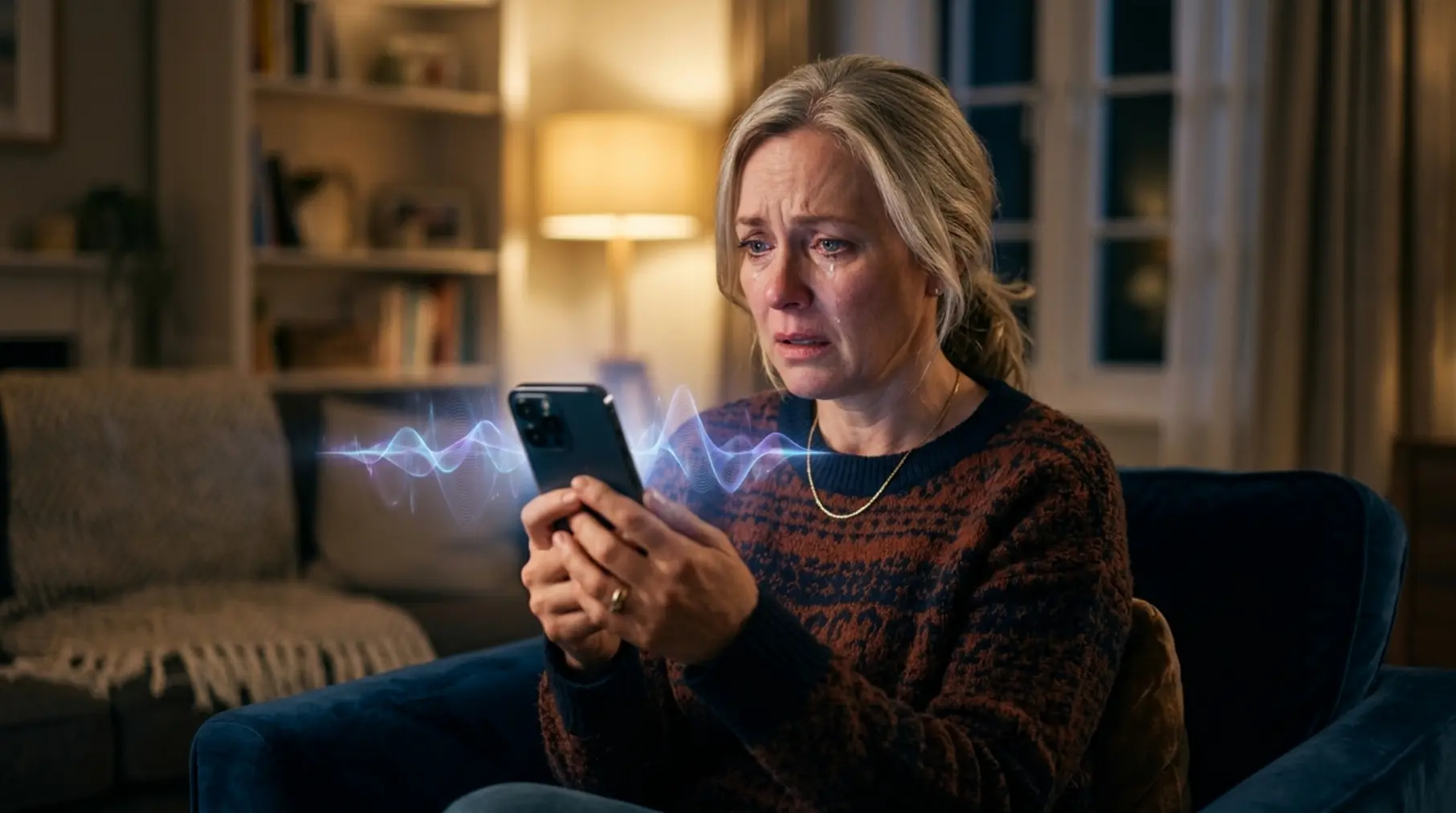
The Evolution of Deception: From Catfishing to AI Voice Cloning
Online deception is not a new phenomenon, but its methods have evolved dramatically. What began with simple text-based lies has now entered an era of synthetic media, where seeing—or hearing—is no longer believing. To appreciate the gravity of the current threat, it is helpful to understand its technological progression.
The Early Days: Text, Stolen Photos, and Pre-Recorded Messages
Initially, romance scammers, often known as “catfish,” relied on a simple toolkit. They would create fake profiles using stolen photographs of attractive individuals—models, soldiers, or successful professionals. Their entire interaction was confined to text: emails, instant messages, and texts. The narrative was their primary tool, weaving elaborate stories of being a widower working on an oil rig, a military doctor deployed overseas, or an international businessman facing a temporary crisis. The main weakness of this method was the scammer’s inability to provide real-time, verifiable proof of their identity. Any request for a phone call was met with excuses: a bad connection, a broken phone, or strict security protocols at their supposed workplace. This was often a red flag for savvy individuals, a crack in the facade that could expose the entire lie.
The Game Changer: How AI Voice Cloning Works
Today, that primary red flag has been effectively neutralized by artificial intelligence. Voice cloning technology, once the domain of high-tech research labs, is now widely accessible. The process is alarmingly simple. A scammer only needs a small audio sample of a person’s voice to create a digital replica. This sample can be lifted from a public source like a YouTube video, a podcast interview, or a social media post. In some cases, just a few seconds of audio is sufficient for the AI to learn the unique characteristics of a person’s voice: their pitch, cadence, and accent.
Once the AI model is trained on this sample, the scammer can type any text, and the software will generate an audio file of that text spoken in the cloned voice. The quality is astonishingly realistic, complete with natural-sounding inflections and emotional tones. This means a scammer who has stolen the identity of a real person can now “speak” to their victim in that person’s voice, leaving voice notes that sound completely authentic. They can say “I love you,” “I miss you,” or, more dangerously, “I’m in trouble, I need your help,” all with a voice that the victim has come to trust and associate with the person in the photographs.
The Psychological Weapon: How AI Voice Manipulates and Persuades
The introduction of AI-generated audio into romance scams is not merely a technological upgrade; it is a profound psychological escalation. It preys on the fundamental human need for connection and exploits the deep-seated trust we place in the sound of a familiar voice. This makes the scam more immersive, more believable, and significantly more difficult to detect.
Building a Deeper, More “Authentic” Connection
A relationship built solely on text messages can feel distant and abstract. A scammer can write poetic words, but the victim is always aware they are reading, not hearing. An authentic voice changes everything. Hearing the “person” laugh at a joke, sigh after a long day, or whisper goodnight creates a powerful illusion of presence and intimacy. The victim is no longer just communicating with a profile; they are bonding with a voice. This deepens the emotional investment, making the victim more attached and less likely to question inconsistencies in the scammer’s story. The AI voice becomes the glue that holds the fabricated reality together, transforming a collection of lies into a seemingly tangible relationship.
Manufacturing Crisis and Urgency with Frightening Realism
The most dangerous application of AI voice cloning is in the final, exploitative phase of the scam: the request for money. Scammers thrive on creating a sense of crisis that requires an immediate financial response. Before AI, this was done through frantic texts. Now, it is done through a panicked voice note or even a short, faked phone call.
Imagine receiving a message in the voice of someone you believe you love, their tone filled with fear and desperation. “Darling, it’s me. There’s been a terrible accident. I’m in the hospital, and they won’t treat me until I can pay a deposit. The connection is terrible here, I can’t talk for long. Please, you have to send the money to this account right away. I’m scared.” The emotional impact of hearing these words, in that specific voice, is designed to bypass rational thought. It triggers a primal instinct to help and protect, overriding any lingering doubts. The victim’s brain is not processing a request; it is reacting to the distress of a loved one. This is a core tactic used in many devastating romance scams where urgency is key to the fraud’s success.
Overcoming Objections and Erasing Doubt
As a scam progresses, victims may naturally develop suspicions. The person’s inability to ever video chat, their constant excuses, or the escalating financial requests might start to raise red flags. In the past, this was a critical juncture where the scam could fall apart. Now, the AI voice is used as a tool to quell these exact doubts. When a victim says, “I’m not sure if you’re real,” the scammer can respond with a seemingly heartfelt voice note. “Of course, I’m real. How can you say that after everything we’ve shared? Just hearing you doubt me is breaking my heart. Listen, it’s me. It’s always been me.” Hearing this reassurance in the voice they’ve grown attached to can be enough to silence their inner critic and pull them back into the deception, reinforcing the cycle of manipulation.
Your Defense Toolkit: How to Verify Identity in the Age of AI
In this new environment, you must operate with a “trust but verify” mindset. While AI has made deception easier for scammers, it has not made it foolproof. There are still reliable methods to confirm someone’s identity, but they require you to move beyond passive listening and engage in active verification.
The cardinal rule is this: A voice note or a short phone call should be treated as supporting evidence, not definitive proof of identity. It can be part of the picture, but it should never be the entire picture. The following strategies are essential for protecting yourself.
Demand a Live, Interactive Video Call
This remains the single most effective method of verification. While deepfake technology exists, faking a real-time, interactive video conversation is exponentially more difficult than faking a static voice note. A scammer can pre-generate audio, but they cannot easily generate real-time video responses to your specific, unscripted commands.
- Insist on a live video call. Do not accept excuses like a broken camera, a bad internet connection, or security restrictions. These are classic red flags. A legitimate person will find a way to make it happen.
- Make it interactive. During the call, ask them to perform specific actions. Say things like, “Please touch your left ear,” “Wave at me with your right hand,” or “Show me the book that’s on your desk.” A scammer using a stolen or pre-recorded video loop (a common tactic) will be unable to comply with these random requests.
- Look for inconsistencies. Pay attention to how their mouth movements sync with the audio. Is there a noticeable lag? Does the lighting in their video match the time of day it’s supposed to be in their location?
Use Shared Knowledge and “Digital Safewords”
Scammers can scrape public data from social media, but they cannot know your private, shared history. This is a powerful vulnerability you can exploit for verification.
- Ask specific, personal questions. Formulate questions whose answers cannot be found online. Instead of “Where did you go to college?” (easily found on LinkedIn), ask “What was the funny name we came up with for the waiter at that Italian restaurant we talked about last month?”
- Establish a safeword or phrase. Early in a relationship, you can agree on a secret word or question. If you ever have doubts or receive an urgent request for money, you can ask for the safeword. If they cannot provide it instantly, it is a scam.
Verification must happen through an independent channel. If someone calls you claiming to be a loved one in trouble, your first action should be to end the call and immediately contact that person or a known family member using a phone number you already have in your contacts. Do not trust any contact information provided by the potential scammer.
The goal is to break out of the closed loop of communication that the scammer controls. By contacting someone through a trusted, pre-existing channel, you can quickly and easily verify the story. This simple step can stop a scam in its tracks. A genuine emergency will be confirmed by other family members; a fake one will be exposed instantly. The complex nature of these manipulations is why victims often need professional help to navigate the aftermath of romance scams.
What to Do When You Suspect a Scam or Have Become a Victim
Realizing you might be the target of a romance scam, especially one involving sophisticated technology like AI voice cloning, can be a distressing and confusing experience. It is crucial to act decisively to protect yourself and begin the process of recovery.
First and foremost, if you receive an urgent request for money, stop. No matter how convincing the voice or story, do not send any funds, gift cards, or cryptocurrency. Cease all communication with the suspected scammer immediately. Do not accuse them or try to get them to confess; this may only cause them to erase their profiles and disappear. Instead, preserve all evidence. Take screenshots of their profiles, save all text conversations, and, importantly, download and save any voice notes they have sent you. Keep records of any financial transactions, including recipient account details or crypto wallet addresses. This evidence is vital for law enforcement and for any recovery efforts.
Navigating the complex world of international financial fraud is not something you should do alone. These criminal networks are experts at moving and hiding money across borders. This is where professional assistance becomes invaluable. A specialized fund recovery firm like Nexus Group has the experience, technology, and global network to trace and challenge these illicit transactions. We work with financial institutions and legal systems to reclaim what was stolen from you.
At Nexus Group, we understand the devastating impact of these crimes. That’s why we offer a clear promise to our clients: we guarantee the recovery of your funds, or you get your money back. This commitment ensures that you can pursue justice without taking on additional financial risk. Our mission is to fight for you and hold these criminals accountable for the emotional and financial damage they cause through tactics like romance scams.
The emotional toll of being a victim is immense, often accompanied by feelings of shame or embarrassment. It is important to remember that you are the victim of a calculated crime perpetrated by sophisticated criminals using advanced technology. There is no shame in being deceived. The most important step you can take is to seek help, both for your financial recovery and your emotional well-being. By acting quickly and engaging experts, you can shift from being a victim to being a survivor.
If you or someone you know has been targeted by a scam involving AI voice notes or any other form of online fraud, do not hesitate to reach out. The digital world has new dangers, but you do not have to face them alone. Contact us
